 how-to
How to Prevent Graphic T-Shirt Prints From Peeling
Table of Contents
- Why Graphic T-Shirt Prints Peel, Crack, and Fade
- How to Wash Graphic T-Shirts Without Damaging the Print
- How to Dry Graphic T-Shirts to Protect the Design
- How to Fix a Peeling Decal on a Shirt (and When to Stop)
- The Best Way to Store Graphic T-Shirts for Long-Lasting Prints
- Care Instructions by Print Method: Screen Print vs. Heat Transfer
- Prevention From the First Wash: Building Habits That Protect Your Prints
- Frequently Asked Questions
Last Updated: October 14, 2026
Why Graphic T-Shirt Prints Peel, Crack, and Fade
A printed design fails for one simple reason: heat, friction, and harsh chemicals break the bond between the ink and the fabric, which is why the smartest way to prevent graphic t-shirt prints from failing is to control those three forces. At Sweetpea Manor Designs, we print and ship faith-based tees, and we want every shirt to hold up long after it leaves us.
The Most Common Causes of Print Damage
Print damage rarely happens in one wash. It builds up.
- High dryer heat softens the ink until it lifts at the edges
- Rubbing against other clothes wears down the printed image
- Bleach and harsh detergent break down the ink over time
- Washing right-side out lets the print scrape the drum
- Fabric softener coats the print and weakens adhesion
A common mistake is blaming poor print quality for damage that actually came from the laundry routine.
How to Wash Graphic T-Shirts Without Damaging the Print
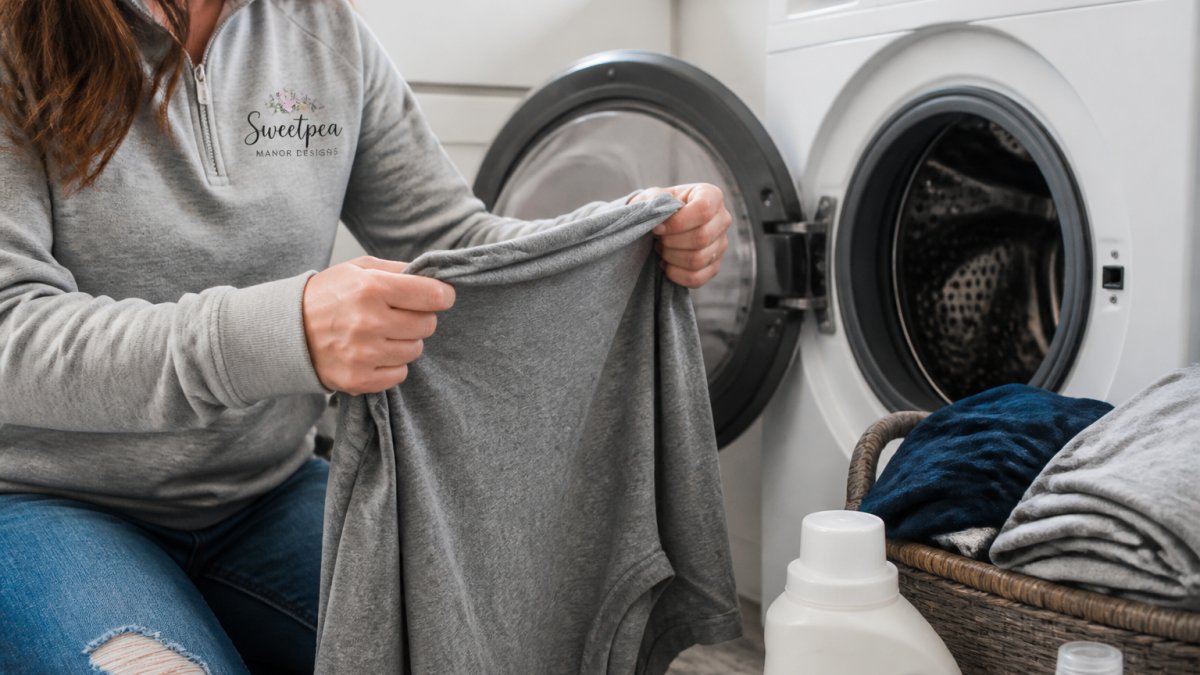
Wash graphic t-shirts inside out in cold water on a gentle cycle, then skip the dryer entirely. That single routine protects the printed image more than any specialty product. Here is the step-by-step version we share with our customers:
- Turn the shirt inside out so the print faces inward
- Close zippers and buttons on nearby items to reduce snags
- Wash with like colors in cold water
- Choose a gentle or delicate cycle
- Use a small amount of mild detergent
- Skip bleach, fabric softener, and dryer sheets
- Remove the shirt promptly when the cycle ends
Water Temperature, Cycle, and Detergent Choices
Cold water is the safest choice for any printed shirt. Heat is what makes ink soft and tacky, and soft ink sticks to whatever it touches.
Set your washer to a gentle or delicate cycle with a low spin speed. Fast spinning presses the print against the drum and other garments, which is where most friction damage happens.
For detergent, pick a mild, liquid formula without added bleach or brighteners. According to the American Cleaning Institute's laundry guidance, using the right amount of detergent matters as much as the type, since too much leaves residue behind.
How to Dry Graphic T-Shirts to Protect the Design
Air drying is the single best way to protect a printed design. Hang the shirt inside out on a line or drying rack, away from direct sun. Sunlight fades ink over time, so a shaded spot works best.
If you must use a dryer, choose the lowest heat setting and pull the shirt out while it is still slightly damp. High heat is the number one cause of cracking, because it makes the ink brittle.
How to Fix a Peeling Decal on a Shirt (and When to Stop)
Small lifts at the edge of a print can sometimes be pressed back down. Set the shirt on a flat surface, cover the peeling area with a thin cotton towel, and press with a warm iron for 10 to 15 seconds. Let it cool completely before moving the shirt.
A few honest limits apply here:
- This only works on heat-transfer prints, not screen prints
- It works best on small edge lifts, not large flakes
- Never place the iron directly on the ink
- Never use a heat gun, which can scorch the fabric
If the print is cracking across the middle or flaking off in pieces, the bond is gone. No repair will bring it back.
The Best Way to Store Graphic T-Shirts for Long-Lasting Prints
Fold graphic t-shirts rather than hanging them, and keep the printed side facing inward. Hangers stretch the shoulders and let the shirt rub against whatever hangs beside it.
Store folded shirts in a cool, dry drawer or shelf. Avoid damp basements and hot attics, since both speed up ink breakdown.
For seasonal items, like our autumn and Christmas designs, a breathable cotton storage bag beats a sealed plastic bin. Plastic traps moisture, which can lift a print over a long summer in storage.
Care Instructions by Print Method: Screen Print vs. Heat Transfer
Not every graphic is built the same way, and treating a direct-to-garment print like a heat-transfer vinyl print is one of the fastest ways to shorten a shirt's life. The care routine should follow the print method, not just the fabric.
Here is how the four most common methods behave, and how to wash and dry each one.
Screen Printing
Screen print ink is pushed through a mesh screen and cured at high heat, so it sits as a thick layer on top of the fabric. That layer resists cracking well, but it fades faster than other methods when bleach or harsh detergent is used. Wash screen-printed tees inside out in cold water on a gentle cycle, and air dry when you can. A low dryer setting is usually tolerable, but repeated high heat will dull the ink over time.
Heat-Transfer Vinyl (HTV)
HTV is a film that is pressed onto the fabric with a heat press. The bond depends on the carrier film staying flat against the shirt, which is why the edges are the first place to lift. Wash HTV shirts inside out in cold water, skip the dryer entirely, and never iron directly on the film. If an edge starts to lift, a warm iron over a cotton towel can sometimes press it back down, but only on small lifts.
Direct-to-Garment (DTG)
DTG printers spray water-based ink directly into the fabric fibers, so the print sits in the shirt rather than on top of it. DTG prints feel softer but can fade and crack faster if the shirt is washed in hot water or dried on high heat. Cold water, gentle cycle, and air drying are the safest routine. A pre-treatment is often applied before printing, and that pre-treatment can leave a slight discoloration if the shirt is exposed to bleach.
Sublimation
Sublimation ink turns into gas and bonds with polyester fibers, so the design becomes part of the fabric rather than a layer on top.
| Print Method | How the Ink Bonds | Main Risk | Wash Setting | Dry Setting |
|---|---|---|---|---|
| Screen print | Cured ink layer on top of fabric | Fading from bleach and harsh detergent | Cold, gentle cycle | Air dry or low heat |
| Heat-transfer vinyl | Pressed film adhered to surface | Edge peeling and lifting | Cold, gentle cycle | Air dry only |
| Direct-to-garment | Water-based ink sprayed into fibers | Fading and cracking | Cold, gentle cycle | Air dry or low heat |
| Sublimation | Gas-bonded into polyester fibers | Dulling from fabric softener | Cold, gentle cycle | Air dry or low heat |
Always check the garment care label first. It reflects how that specific shirt was made, and it is the most reliable starting point for any printed tee.
As a small mom-and-pop shop, we print and ship faith-based tees every week, and we want every shirt to hold up long after it leaves us.
Prevention From the First Wash: Building Habits That Protect Your Prints
The first wash sets the pattern for everything that follows. Treat a new graphic tee the same way you plan to treat it for the next two years: inside out, cold water, gentle cycle, air dry. But the first wash is not just about the wash itself. It is about reading the label, understanding any curing instructions, and building a routine you can repeat.
Read the Care Label Before the First Wash
The care label is the most reliable guide for any printed shirt. It tells you the fiber content, the recommended water temperature, and whether the garment can be tumble dried. For printed tees, the label often includes a note about washing inside out or avoiding fabric softener. If the label says dry clean only, follow it. If it says machine wash cold, that is your baseline.
Check for Curing Instructions
Some print methods, especially heat-transfer vinyl and direct-to-garment, come with curing instructions from the printer or brand. Curing is the process that sets the ink or film so it bonds properly. If a shirt was not fully cured, the print may peel faster no matter how carefully you wash it.
The First-Wash Timeline
- Day 1: Wear the shirt if you like, but avoid heavy sweating or spraying perfume directly on the print.
- First wash: Turn the shirt inside out, use cold water, gentle cycle, and a small amount of mild detergent. Skip bleach, fabric softener, and dryer sheets.
- First dry: Air dry the shirt inside out on a line or drying rack, away from direct sun. If you must use a dryer, choose the lowest heat setting and remove the shirt while it is still slightly damp.
- After the first wash: Inspect the print for any edge lifting or cracking. If you see a small lift, press it with a warm iron over a cotton towel before it gets worse.
- Ongoing: Repeat the same routine for every wash. Consistency matters more than any single product.
Habits That Pay Off Over Time
- Keep a small mesh laundry bag for printed shirts
- Wash graphic tees in their own small load when you can
- Skip the dryer for anything you want to keep crisp
- Reapply these habits to every new shirt, not just the first one
- Store folded shirts in a cool, dry place, with the printed side facing inward
As a small mom-and-pop shop, we care about how our shirts hold up long after they leave us. Every order ships through our Shopify store, our Etsy shop, our Printify site, eBay, and TikTok Shop, and our product list keeps growing. Ordering is simple, and our autumn and Christmas designs are ready now for the holiday season.
the FTC's guidance on caring for textile products notes that care labels are required on most garments, which makes them a reliable starting point for any printed shirt.
Frequently Asked Questions
Why do graphic t-shirt prints crack or peel?
Prints crack or peel when the bond between the ink or vinyl and the fabric breaks down. High heat from a dryer, harsh detergent, bleach, and friction from other clothes all speed up that breakdown. Washing in cold water, turning shirts inside out, and air drying are the simplest ways to prevent graphic t-shirt prints from peeling over time.
Should you turn a graphic t-shirt inside out before washing?
Yes. Turning the shirt inside out puts a layer of fabric between the print and everything else in the wash drum. That reduces rubbing against zippers, buttons, and other garments, which is one of the main causes of peeling and cracking. It takes a few extra seconds and adds months to the life of the print.
Can heat from a dryer make a shirt print peel?
High dryer heat softens the adhesive and ink that hold a print to the fabric. Once that bond weakens, edges lift and peel. Use the lowest heat setting or air dry the shirt on a line or rack. If you must use a dryer, remove the shirt while it is still slightly damp and hang it to finish drying.
How do you fix a peeling decal on a shirt?
Lay the shirt flat on an ironing board with the peeling area facing up. Cover it with a thin cotton towel or parchment paper and press with a warm iron for 10 to 15 seconds, then let it cool completely before wearing or washing. This works on small lifted edges. Large sections that have already separated usually cannot be reattached reliably.
Graphic tees only last as long as the care behind them. If you want faith-based apparel built to be worn and washed for years, Sweetpea Manor Designs offers quality printed shirts, home goods, and personalized items made by a small family team. Browse our growing collection, including new autumn and Christmas designs, and find a piece that shares your faith every day.